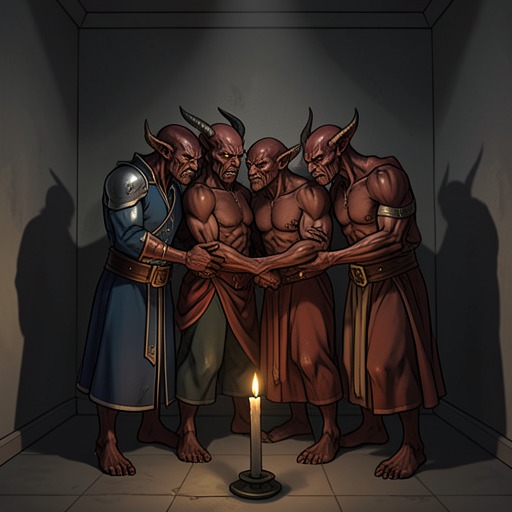
Malthios’s Rebirth as Theo’s Host
The Reincarnated Demon King's Host Just Wants to Live in Peace, But the Hero Won't Leave Him AloneMalthios’s Rebirth as Theo’s Host is the decisive supernatural event that reshapes the entire conflict between the former Demon King and the human healer Theo. Malthios survives by being reborn within a host, but the result is not a simple restoration of power: he awakens trapped inside a developing human body, dependent on Theo’s consent and vulnerable to the boy’s resistance. Their antagonistic bond becomes the hidden structure beneath Theo’s life, his fear of discovery, and the later question of whether Malthios must be destroyed or can be contained without sacrificing Theo.
Rebirth and Loss of Physical Agency
When Malthios finally awakens, he experiences existence as weight, darkness, and disembodied perception. He cannot move his limbs or see independently; instead, he looks outward through another body, first seeing the beams of a cottage roof and a green-eyed human woman leaning over him. His attempted attack produces no result. The only movement available to him is an infant’s chubby hand reaching for the woman’s braid, a humiliating contrast between the power he once possessed and the helpless body into which he has been placed. The rebirth spell has succeeded, but it has not restored Malthios as an autonomous being. He is now housed within a mortal host whose body is still growing. Malthios immediately interprets the arrangement as a problem of control, assuming that the host can eventually be mastered and that the two of them can pursue great aims together. His first impulse is therefore strategic rather than affectionate: he regards Theo as a vessel to command, not as a person with an independent will.
Theo’s Resistance and the Shared Body
The first years establish the central limitation of the host bond. Theo possesses powerful magical potential for a mortal, but Malthios cannot simply seize his body. He can attempt to pressure Theo into actions that test obedience, yet the human repeatedly resists. Even when Theo suffers a lapse of control that briefly gives Malthios an opening, Theo manages to force him back and reclaim the body. The former Demon King is consequently not the sovereign presence he imagines himself to be, but a consciousness confined by the will of the person who physically carries him. This constraint produces constant antagonism. Malthios finds the arrangement infuriating, especially when Theo begins to acknowledge him rather than merely endure an unexplained presence. The human body also carries emotional reminders of Malthios’s former life: Theo’s auburn hair and fluorite-green eyes recall Kamil, while his reserved, prickly demeanor evokes Aym, his dry humor resembles Foras, and his stubborn resolve recalls Tori. Those similarities dredge up memories Malthios had tried to leave behind, making Theo’s presence both a prison and an involuntary archive of the relationships he once possessed. Their conflict becomes more personal when Malthios urges Theo to retaliate against village children who have bullied him. After Theo flees instead, Malthios tries to take control and condemns what he sees as weakness. Theo answers that the ability to suppress Malthios proves otherwise, but the force of the reply is undermined by his crying. The exchange exposes the asymmetry of their situation: Malthios has power, experience, and intimidation, while Theo possesses the decisive authority over the shared body. Theo’s outburst, insisting that his name is Theo and that Malthios should use it, is the first clear demand that the supposed vessel be recognized as a person.
Secrecy, Fear, and Recognition
The host bond makes Theo’s identity dangerous. He understands that friendship alone would not save him if anyone discovered what he was, because the truth would define him as the vessel of the Demon King rather than as the healer and community member he has become. His secrecy is therefore not merely private embarrassment; it is a survival strategy shaped by the knowledge that exposure could lead to coercion, imprisonment, or execution. Malthios’s presence intensifies that danger while also making complete isolation impossible, since the hidden demon is the one companion who knows Theo’s condition from within. Cargo eventually voices the concealed truth directly, asking Theo whether he will ever tell the others that he is demon spawn. Theo’s body freezes and his fingers nearly drop the basket he is carrying. The physical shock arrives before any explanation, revealing how deeply the secret governs his daily life. Malthios immediately stirs and tries to move forward to defend them, but Theo can only respond with a question while his heart pounds in his throat. The scene turns revelation into a bodily crisis: the threat is not abstract, and being recognized as the host could alter every relationship around him. When Bryony later brings a portal and permission to retrieve Theo, he understands that entering the capital will end his autonomy. The powerful people there will know where he lives, and Camden will recognize him; they may force him back into the Hero’s party, where the truth about Malthios could be exposed. Theo still chooses to go because Luc may die if no one intervenes. His decision shows the host bond operating within a larger moral conflict: protecting Luc requires Theo to risk the discovery that could destroy his own life.
Public Judgment and the Choice to Delay Death
The consequences of the rebirth eventually become public in the Trial of the Demon King’s Host. With a court mage, knights, a rare Portal Orb, and magical restraints involved, Theo is transported to the capital and taken to the dungeons after confirming what he is. The court treats the host condition as a criminal matter before it treats Theo as an individual. His emotional pain is sharpened by Luc’s silence and by the sight of Julius, Luc’s former lover, among those escorting him. Theo’s private bond with Malthios is then placed against the political judgment of the court. Leafel refuses to abandon him. Micah opens a powerful mirror spell from the village square, with Imani, Dale, Dmitri and his parents, Nib, Amaya, Hayden, and the people of Leafel gathered behind him. Hayden demands Theo’s release on behalf of the town. Their intervention changes the meaning of the host identity: the person the court sees as a threat is also a healer whose community publicly claims him. Malthios further complicates the judgment by admitting that he destroyed the Demon Fortress and those within it. He argues that only a few lesser demons and demon-created monsters may remain and that there is no longer any need for a Hero. Luc nevertheless declares that, as the Hero, it is his duty to kill the Demon King. The statement appears to return the host bond to its original logic of inevitable destruction, but Luc immediately adds that he can choose when that duty is fulfilled. The distinction between duty and timing creates the possibility of restraint without denying the danger Malthios represents. Malthios asks Luc to call him Mal, the name given by his friends and used by Theo, and asks him to make a good choice. Theo then retakes control, while Luc turns to the silent observers and commits himself to a decision that preserves both responsibility and time. The final judgment sentences Demon King Malthios to life in prison while clearing Healer Theo Bladefoot of every charge. The result neither treats Malthios as harmless nor condemns Theo for carrying him. It transforms execution into containment and separates the host’s moral responsibility from the demon’s identity.
Narrative Significance and Aftermath
The rebirth reverses the usual hierarchy between a Demon King and a human host. Malthios begins with the expectation that Theo will be an instrument, yet Theo’s resistance makes the human body the governing power. Physical confinement gradually exposes Malthios to memories, vulnerability, and forms of dependence that his former status had concealed. Theo, meanwhile, is not simply liberated by possessing control; he must live with the knowledge that the consciousness inside him can endanger everyone he loves. The event also turns identity into a continuing negotiation rather than a fixed revelation. Cargo’s question, Leafel’s public defense, and the capital trial each stage the same secret differently: as stigma, as communal knowledge, and as a legal accusation. By the ending, the host bond has not disappeared, but its meaning has changed. Malthios remains dangerous and is sentenced to life imprisonment, while Theo returns to the protection of a community that recognizes him as more than the body containing an enemy. The rebirth thus initiates the story’s central possibility: that survival may require neither simple innocence nor simple destruction, but a difficult coexistence governed by resistance, attachment, and chosen restraint.